
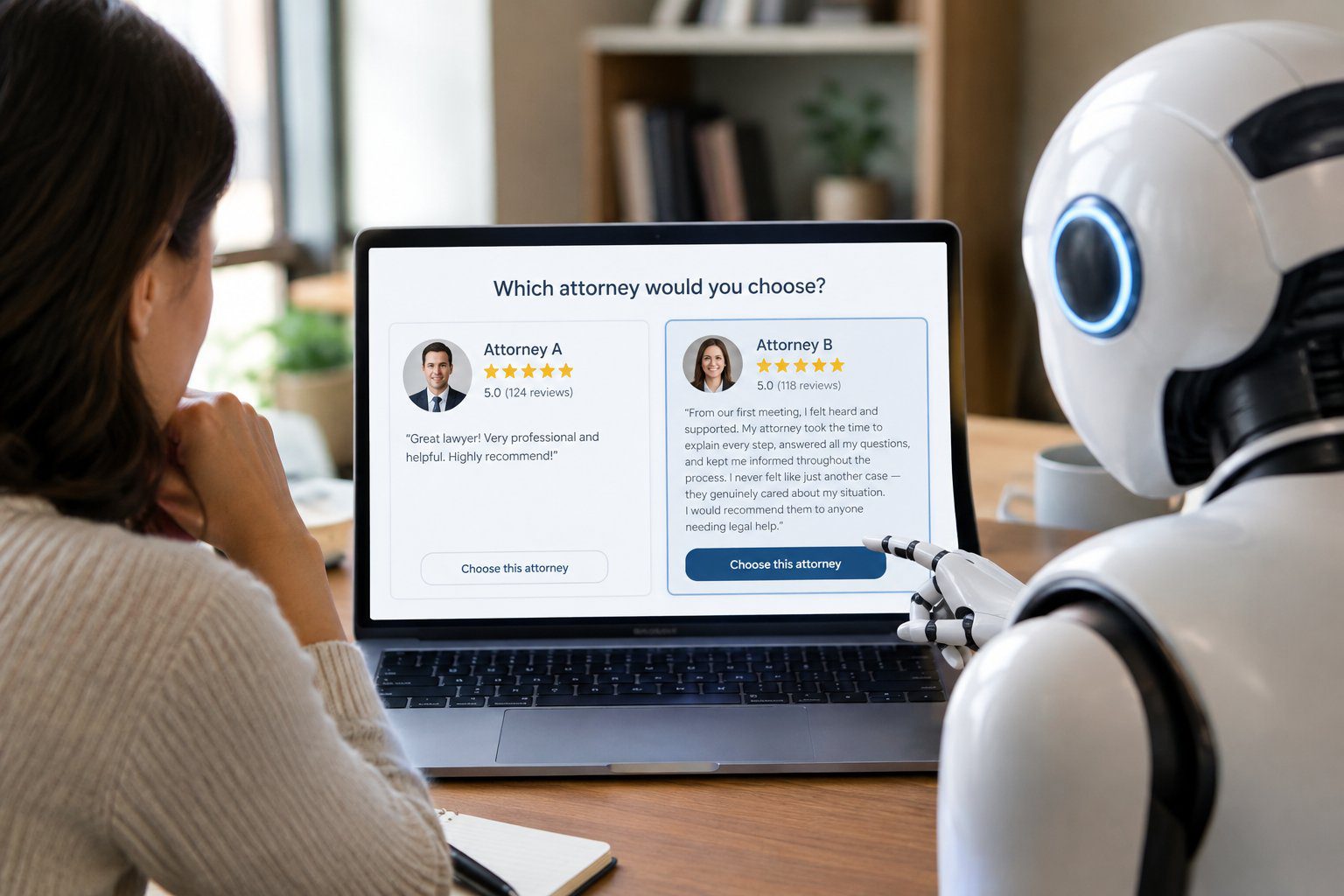
Law firms get better reviews by asking clients two or three open-ended questions at case closing instead of just asking for five stars. Reviews that name the case type, the process, or the outcome carry more weight with prospective clients and with AI assistants than a short rating does.
Key Takeaways
|
Every firm we work with knows they should have more reviews. That’s great, but it’s also not the problem. Too many don’t have a reliable, consistent process for getting them, and the ones who do usually have a process built around quantity versus quality.
Obtaining a certain number of reviews worked for a long time. Someone typed “car accident lawyer Nashville,” got a map with three listings and a row of stars, and the higher star count usually won the click. Under that system, a firm with 300 reviews saying “Great lawyer!” beat a firm with 25 detailed ones, and the fastest way to win was volume.
Volume still helps. But the review you collect today has a second job, because a growing share of prospective clients are not typing four words into a search box. They are describing their whole situation to ChatGPT or Google’s AI Mode, in a paragraph, and getting back an answer with a few firms named in it. Whatever is written in your reviews is text that can be read, matched, and quoted.
So, the question is not how to get more reviews (because almost any client will be happy to leave a quick 4- or 5-star review simply upon the asking of it). The question now is how to get reviews that say something, and how to ask for them without stepping on a bar rule. Here is a detailed guide walking you through each step of that process.
Why Do Law Firm Reviews Matter More Than They Used To?
The importance of reviews is nothing new. In the legal sector, prospective clients naturally place far greater faith in real human experiences than in advertising or social media campaigns. Because law falls squarely into the Your Money or Your Life (YMYL) domain, independent recommendations carry profound significance when individual well-being, family stability, or commercial interests are at stake. Even so, a long-standing factor combined with a more recent development have made client reviews significantly more critical to your firm’s online presence than in years past:
- Google Explicitly Rewards Local Prominence: Google’s local ranking algorithm relies on relevance, distance, and prominence. Google officially states that “more reviews and positive ratings can help your business’s local ranking.” Prominence directly determines whether your firm appears in the local map pack, where a massive share of client consultations still begin.
- AI Assistants Parse Reviews as Core Context: Modern AI tools synthesize direct answers instead of returning ten blue links. To generate those answers, AI systems read full-page web content. Reviews serve as a continuous stream of authentic text written by real people about your legal services, which is the exact material AI engines pull from to generate firm recommendations.
Because reviews now dictate both map rankings and AI recommendations, the industry has been flooded with aggressive advice on how to “hack” them. To ensure you focus on what actually moves the needle (without risking compliance violations), it helps to separate documented ranking factors from marketing noise – see the below table for what this looks like.
| Claim You Will Hear | Status | What to Actually Do |
| More reviews and better ratings help local ranking | Documented by Google | Keep collecting them steadily. |
| You need a set number of reviews per month | Not documented anywhere | Focus on steady accumulation; arbitrary quotas are pure speculation. |
| Get clients to use specific keywords in reviews | Not documented; creates Bar & FTC compliance issues | Ask open-ended questions that prompt detailed, natural client responses instead (see below). |
Reviews matter more today because they fuel both traditional map algorithms and emerging AI search tools. However, their growing importance doesn’t mean you need complex tricks. The real engine of modern discovery is simply the steady accumulation of rich, authentic text written by satisfied clients, which is the one element you can directly cultivate through great client experiences.
What Makes a Review Worth Having?
Three things make a review worth having, and none of them is a star count.
- Specificity. “John is a great attorney!” contains no case type, no jurisdiction, no procedure, no timeline, and no outcome. When somebody asks for an empathetic probate attorney who handles contested wills, there is nothing in those five words to match against. There is nothing in it for a human reader either, which is the part people skip.
- The client’s own vocabulary. A review that mentions a custody schedule for shift workers tells a reader you have handled non-standard visitation. It also happens to contain the words a person in that exact situation would use to describe their own problem.
- Recency. Reviews are the only part of your online presence that keeps producing new third-party text about your practice, and they also come with dates. A review page whose most recent entry is from 2023 communicates something regardless of whether any algorithm notices.
The table below attempts to show the difference in practice between a traditionally passable review versus newer, preferred reviews.
| A review that shows nothing | A review that says something |
|---|---|
| “Great firm, highly recommend!” | “They handled a contested will after my brother challenged our mother’s executor.” |
| “Very professional and knowledgeable.” | “They explained the probate timeline honestly, including the part where it was going to take longer than I wanted.” |
| “Best lawyer in Nashville.” | “I called three firms. This was the only one that called me back the same day and gave me a straight answer about cost.” |
| “5 stars!!!” | “My case was a straightforward uncontested divorce, and they did not try to talk me into anything more complicated.” |
Nobody writes the right hand column because you asked for five stars. They write it because you asked them a question.
Can Law Firms Ask Clients for Reviews?
Yes, and most firms already do this correctly. Three separate rulebooks apply, and they get mashed together into one vague warning about “compliance,” which helps nobody.
| Rulebook | What it actually prohibits | Who enforces it |
|---|---|---|
| FTC Consumer Reviews and Testimonials Rule, effective October 21, 2024 | Fake reviews, incentives conditioned on a particular sentiment, threatening reviewers to suppress reviews, and undisclosed reviews from employees or family | Federal Trade Commission, with civil penalties for knowing violations |
| Platform policies | Google prohibits offering payment, discounts, or free goods and services in exchange for a review. Yelp asks businesses not to solicit reviews at all, and filters ones that look prompted | The platform, typically, by removing your reviews |
| ABA Model Rules 7.1, 7.2(b), and 1.6 as adopted in your state | Misleading claims about your services, giving anything of value to a person for recommending your services beyond nominal gifts of appreciation, and revealing client confidences | Your state bar |
One clarification on the FTC rule, since it often gets misquoted. It does not ban asking for reviews, and it does not ban incentives outright. What it bans is conditioning the incentive on the review being positive. Your bar rules are the stricter constraint anyway, because Rule 7.2(b) limits giving anything of value to a person for recommending your services, with a narrow exception for nominal gifts of appreciation that are not compensation.
Practical version: Ask everyone, thank everyone, pay nobody.
How Should You Ask for a Review?
Replace “please leave us a five star review” with two or three open-ended questions. Not because a checklist says so, but because the answer to a question is longer and more specific than the answer to a request.
Use these in the email or the exit call:
- What was going on when you first called us?
- What did you want to understand before you decided to hire an attorney?
- How did we do at keeping you updated?
- What would you tell someone in the same situation?
These are prompts for the review itself, not a questionnaire you want answered by email. The client reads them, picks the one or two that match their experience, and writes. Somebody staring at an empty review box writes “great firm.” Somebody who just read “what was going on when you first called us” writes about the accident.
Then stop. Do not suggest phrasing, do not ask for a rating, and do not tell them what to mention. Prescribing content is where an ordinary review request becomes an advertising problem, and it is also what makes reviews read like the firm wrote them.
When Should You Ask?
The standard advice is to ask at the conclusion of the matter, and for a flat fee estate plan or an uncontested divorce, that is exactly right. Ask the week the work is delivered, while the client still remembers what it felt like to have the problem.
The trouble is that plenty of your matters don’t conclude for two or three years. A personal injury client who signed in 2024 and settled in 2027 spent most of that time waiting, and by the end, the part they remember most vividly is the waiting. Firms handling long matters often end up with the fewest reviews because they waited too long to ask for one. The clients may have been happy with your services, but they are ready to move on now.
So, for these situations, pick a milestone instead. When something concrete happens, the client feels relief, and they know it’s because of your work, that’s the time to ask.
| Practice Area | Moments worth asking after |
|---|---|
| Personal injury | Liability accepted, a policy-limits offer comes in, mediation resolves, or the client finishes treatment and the case finally moves |
| Family law | Temporary orders entered, a parenting plan is in place, the final decree |
| Criminal defense | Charges reduced or dismissed, a favorable plea, bond granted, probation completed, expungement granted |
| Estate planning | The signing appointment, or the funding follow-up when everything is retitled |
| Probate and estate administration | The estate is opened and the client stops getting calls from creditors, or the final distribution |
| Business and transactional | Closing, entity formation complete, a contract dispute resolved without litigation |
| Immigration | Work authorization received, an application approved, an interview goes well |
The Best Trigger Is a Thank You
When a client says “I don’t know what we would have done without you,” that’s your cue. Tell your staff plainly: if a client thanks you in an email, on a call, or in the lobby, that’s the moment. Respond with something like, “That means a lot. Would you be willing to say that in a Google review? I can send you the link right now.”
Keep the spoken part that short. The questions belong in the message you send afterward, because that is the thing the client will have open when they actually sit down to write. Send it the same day, and if you are on the phone, send it while still on it:
Thank you again for what you said today. It genuinely means a lot to hear it.
If you would be willing to share that publicly, here is the link to leave us a Google review: [your Google review link]
There is no need to write much. A few sentences about any of these would be more helpful than you might think:
- What was going on when you first called us
- How we did at keeping you updated
- What you would tell someone in the same situation
Either way, thank you. It was a pleasure working with you.
That same template does the work at file closing and at a milestone. Change the first sentence to fit the moment, keep the questions, keep the link in the body where their thumb lands. If you want, you can personalize it in some manner, but again, that’s the basic template.
Of course, none of this happens if the staff do not know they are allowed to send it. In a lot of small firms the paralegal has been fielding the thank-you calls for years and assumed asking was the attorney’s job.
Who Asks, and How
The person the client worked with is the best person to send it. That means it could be an attorney but it could also be a paralegal who handled the file, and they should send it from their own email, not a generic firm address or an automated sequence that opens with the client’s name in brackets.
And this is the basic process:
- Ask out loud before you send anything. A one line heads-up on the phone or at the closing appointment, then the link. A cold email asking for a review often gets ignored. An expected one does not.
- Use the channel you already use with them. If your whole relationship happened over text, the request should be a text.
- Send one link, and make it one click. Google gives you a short review link and a QR code right in your Business Profile. Put the link in the message and the QR code on the closing folder or the conference room table.
- Follow up once. One reminder about a week later. Two is pestering somebody who just paid you.
- Never send anyone to Yelp. Yelp’s policy tells businesses not to ask, and its filter tries to identify solicited reviews and keep them out of your rating.
- Put it in the closing checklist. One person owns it, it has a box, the box gets checked. Relying on memory alone makes any review process inconsistent, leading to lost opportunities.
What to Do When a Client Says No to a Review Request
A client won’t usually say “No” directly to you, but they’ll simply ignore the email. Get used to it, too, because many will, and for some practice areas, it is often for a good reason. A criminal defense client, a family law client, or an immigration client may not want their name attached to a public review of a lawyer, and that has nothing to do with how they feel about your work.
Take the no gracefully and immediately. Then, if it fits, offer the alternative: a testimonial for your recommendations page on your law firm website, first name only or initials, with their permission in writing. That takes their confidentiality seriously and still gives you something real to publish.
One thing not to do, and we can’t stress this enough: never screen clients for their sentiment before you send the link. Sending a satisfaction survey and routing only the happy answers to Google is a well known tactic, and it is exactly the kind of review suppression the FTC rule targets. Ask everyone the same way. Somebody who was disappointed is going to tell you either way, and you would rather hear it from them than read it later.
Where Should Your Reviews Live?
Google Business Profile (GBP) first. That is where the map is, that is where the volume is, and that is the one Google has told you affects local ranking. Plus, these reviews are read and used by AI search engines.
It also turns out to be one of the only places a client can act on your request, which surprises most firms. The table below is what the other platforms your members ask about actually do.
| Platform | Can a client leave a review you asked for? | Why it still matters |
|---|---|---|
| Google Business Profile | Yes, with a link or QR code from your profile | The main event. Send everyone here |
| Apple Maps, via Apple Business Connect | No. Apple shows an aggregate rating, pulls reviews from third parties like Yelp, and lets users give a thumbs up or down in the Maps app. There is no review link to send | Claim your directory anyway. It is the default map on every iPhone and it feeds Siri, so your hours, address, and phone number need to be right there |
| Bing Places | No. Bing does not collect its own reviews. It aggregates from third party sites | Claim your directory anyway. Bing is the default on Windows and Edge, which is a lot of work computers, and its index feeds Microsoft Copilot |
| Yelp | Technically yes, but do not ask. Yelp’s policy is not to solicit, and its filter hides reviews that look prompted | Worth reading once a quarter, not worth a campaign |
| Legal directories | Yes on most of them, including Avvo and Martindale | Strong visibility for exactly the searches your clients run |
The short version on Apple and Bing: Claim both listings, fix the information, and stop there. You cannot send a client to either one, and neither collects the written detail that makes a review useful to a reader. Half an hour each, once, and they (generally) stay accurate (though reviewing from time to time is a good practice).
Apple is the one we would not skip, particularly for estate planning, probate, and elder law. The clients calling about those matters are frequently on an iPhone, using the map that came with it, and some of them reach you by asking Siri rather than opening a browser at all.
After that, your legal directory profiles. Avvo, Justia, Martindale-Hubbell, and Super Lawyers pages tend to rank well for exactly the searches prospective clients run, which means they are visible to people and to anything else reading the web. A lot of firms filled these profiles out once, years ago, and have not looked since. If your profile there lists a former firm name, a retired partner, or an address from two offices ago, fix that before you chase anything else. Ambiguity about which listing is actually you is a problem you can solve in an afternoon.
That also explains a pattern that worries firms more than it should. If you have 4.9 stars on Google and 2.0 on Yelp, that is not necessarily evidence of anything shady. Because Yelp filters reviews that look solicited, a firm running a perfectly ethical Google review process can end up with a Yelp page built almost entirely from unprompted complaints. Same firm, same clients, two very different pages, and the reason is platform policy rather than client experience. Read your Yelp page once a quarter. Do not panic about it.
How Should You Respond to a Negative Review?
Carefully, and possibly not at all. This is the one place we would change the standard advice you see in review management content, because the standard advice can put a lawyer in front of a disciplinary committee.
ABA Formal Opinion 496 addresses exactly this, and two things in it matter most.
- A negative online review is not a “controversy between the lawyer and client” for purposes of the Rule 1.6(b)(5) self-defense exception. The fact that a former client said something false about you in public does not unlock your ability to correct the record with information about the representation. Information already in the public record stays confidential, too.
- The opinion lays out what you can do. Ask the site to remove a post that violates its terms. State that the poster was not a client, if that is true. Invite the person to discuss the matter privately. Post that your professional obligations prevent you from responding. And the opinion notes that not responding at all is often the best option, since replying tends to elevate the review and invite more of the same.
Ultimately, if you respond to a negative review, respond carefully because a future client may read the exchange and form an opinion about your judgment.
Algorithms Change. Human Trust Doesn’t.
Reviews are the only piece of your marketing you do not write. That is exactly where their value comes from, and why every shortcut around them eventually costs more than it saves.
Platforms will keep moving. Google will adjust its local algorithm without warning, and AI assistants will continuously change what and how they read. None of that changes what a good review actually does: Give a stranger a specific reason to believe you can handle their specific problem.
