
Just when lawyers are getting accustomed to incorporating AI into their daily routines, a new learning curve emerges: Agentic AI.
In 2024, the legal world was captivated by questions like: Can AI write my blog posts? Attorneys experimented with ChatGPT, debated its ethics, and cautiously began to test its limits. The conversation was almost entirely about words on a page.
In 2026, that conversation is transforming. In its place is a far more consequential one. The question is no longer what AI can say, but what AI can do.
We are moving from Generative AI into the age of Agentic AI. In other words, the reactive, prompt-and-response tools that dominated the last two years might soon be replaced by systems that don’t wait to be asked. They will be able to reason, plan, and execute multi-step tasks on your behalf. In terms of law firm websites and marketing, this might just be the real game-changer for solo attorneys and small law firms. In fact, this might just be the thing standard AI promised but hasn’t yet quite delivered: a more equal playing field.
At LawLytics, we exist to help attorneys take control of their website marketing and attract more clients, more efficiently. Which is precisely why we’ve been watching this shift closely, and why what we’re building next matters more than anything we’ve done before. It’s what we believe will become the gold standard for the next generation of legal marketing technology.
In the meantime, here’s an overview of what Agentic AI might look like in the legal marketing industry and why solo attorneys and small law firms should care about it.
What the AI Shift Means: The “Writer” vs. The “Doer”
This shift hasn’t quite materialized, but it’s happening right now. It’s in the process, and so to understand the shift, it helps to see the contrast directly.
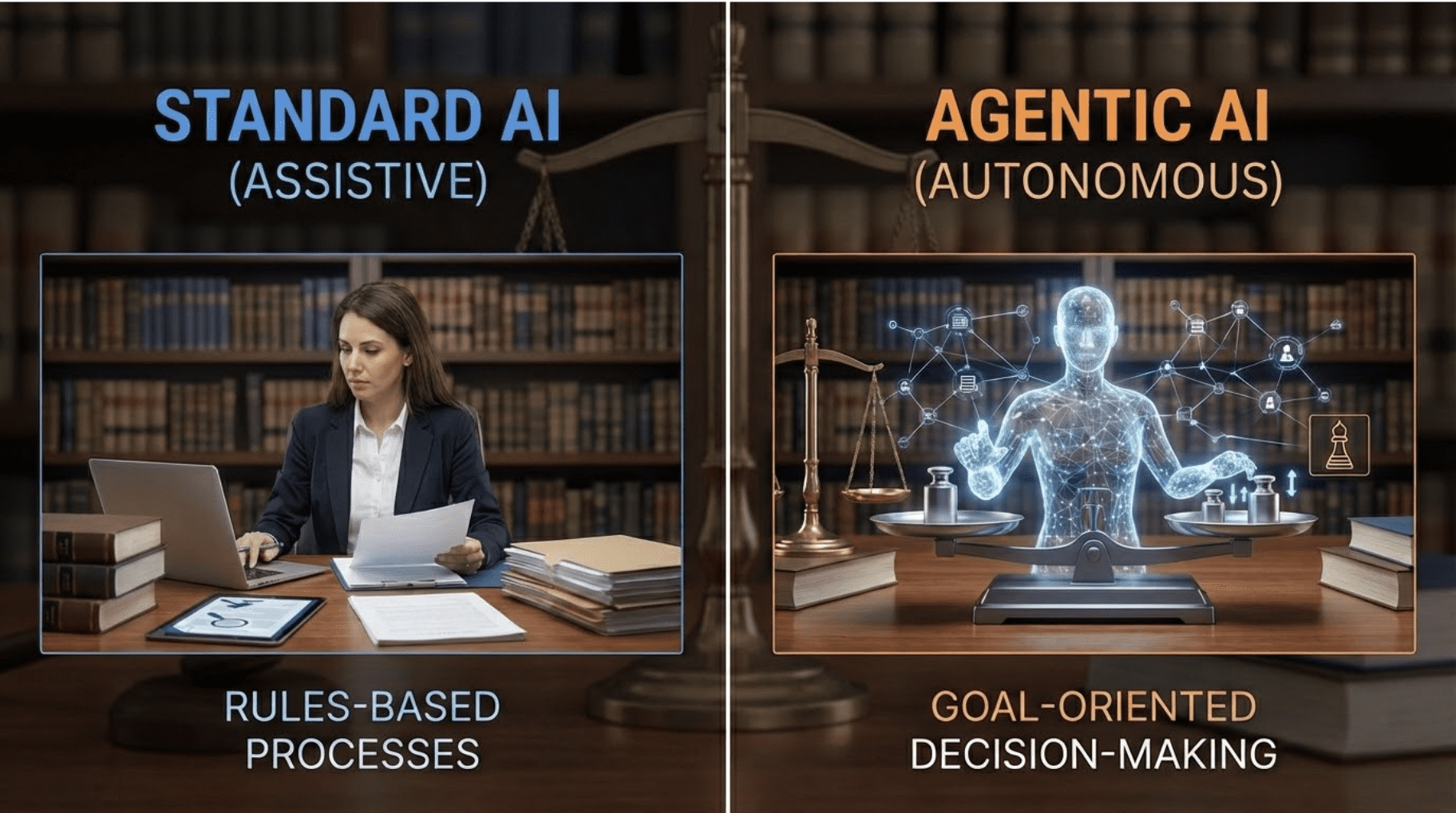
Generative AI, the 2024 standard, is a reactive tool. You type a prompt, for example: “Write a post on family law mediation.” The AI model then responds with an organized blog post. Then it stops. It waits for you to prompt it again. You are the engine; it is the typewriter. The benefit is without doubt: no more white space staring at you. In that sense, it saves time – a lot of time. But you still have to prompt it. It doesn’t draft posts without your instruction to do so.
Agentic AI, the up-and-coming 2026 standard, is a proactive agent. It doesn’t merely write; it reasons through the task, plans a sequence of steps, executes the plan, self-corrects by checking its own work, and then provides a final report. While you remain the essential decision-maker, this functions as your tireless digital associate, requiring neither sleep nor paid time off.
Picture having four specialists on your team: a content strategist, a legal researcher, an SEO expert, and a compliance checker. They all work in the background while you focus on practicing law. That’s what a well-built agentic system will do. It will handle each of those roles in sequence, then surface the finished work for your approval.
Should Solo Attorneys and Small Firms Care about Agentic AI?
Even though Agentic AI for legal marketing purposes is not yet dominating the industry, you should absolutely still care about it. And not just for the incredible benefits it promises, but also because, like standard AI, it introduces new risks. Understanding what you could inadvertently do wrong is crucial to protecting yourself and your law firm. We’ll start with the top benefits, then shift our focus to a necessary word of caution.
Reasons You Should Care about Agentic AI: The Benefits
1. Agentic AI can bridge the staffing gap and compress the advantage gap.
Solo attorneys don’t have marketing departments, intake coordinators, or content teams. Every hour spent on keywords, voicemails, or blog drafts is an hour not spent practicing law or developing business.
Agentic AI changes that equation by handling workflows that used to require dedicated staff (e.g., intake, follow-ups, content production, lead nurturing) without the overhead of hiring. A solo attorney running the right system can operate with the responsiveness of a multi-person team. The firms that adopt this well will look bigger, move faster, and be more available than those that don’t. In a profession where clients often can’t tell the difference between a two-person firm and a fifteen-person firm based on a website alone, that perception matters.
2. Speed and responsiveness are the new competitive edge.
In legal marketing, the firm that responds first often wins the client. Leads go cold fast, sometimes within minutes. Clients expect immediate answers, even at 9pm. A voicemail that doesn’t get returned until the next morning is, for many prospects, reason enough to move on.
Agentic AI will be able to respond instantly, around the clock, in a voice that reflects your firm. It will qualify leads and keep prospects engaged until a licensed attorney takes over. This isn’t just an efficiency story. It directly impacts how many cases you sign.
3. Agentic AI changes how clients find and choose attorneys.
Perhaps the most consequential shift is one that’s already underway, whether firms are ready for it or not. AI-generated answers are increasingly replacing traditional search clicks. Based on how well a firm’s content surfaces in tools like ChatGPT and Google’s AI Overviews, clients form impressions of firms before they ever make contact. Showing up in Google is no longer enough. If your firm isn’t visible in these new discovery channels, you effectively disappear from a growing portion of the market. It won’t be because you did anything wrong, but because the environment shifted around you.
The Big Picture
Agentic AI isn’t simply about doing things faster. It’s about operating with the kind of responsiveness, scale, and visibility that used to require a team, and competing in a discovery environment that looks fundamentally different from the one most small firms built their marketing around.
For solo and small firm attorneys, this isn’t a trend to monitor from a distance. Over time, it becomes the new baseline of what competitive looks like. The firms that understand that early will be the ones setting the standard. The ones that don’t will spend the next several years trying to catch up.
Reasons You Should Care about Agentic AI: The Risks
1. Losing control over client intake and messaging is a real problem.
Agentic systems are increasingly being deployed at the front end of the client relationship. It can respond to inquiries, qualify leads, and manage the first impression your firm makes on someone in a vulnerable, high-stakes moment.
That’s powerful. It’s also a significant exposure point. An AI responding on your behalf may unintentionally cross from marketing into legal advice, imply guarantees, or violate your state bar’s advertising rules — without you knowing it happened. Beyond compliance, your firm’s tone and voice can drift in ways that quietly erode the trust that differentiates you. And if the system edges into territory that resembles the practice of law, you face unauthorized practice of law risk regardless of what your vendor agreement says.
For small firms, intake is the business. Handing that moment to an autonomous system without meaningful guardrails isn’t an efficiency gain. It’s a liability.
2. Agentic AI could expose you to data privacy and confidentiality issues.
Agentic AI runs on data, and the more context it has, the more effectively it acts. That’s also what makes it dangerous in a legal context. Consumer-grade tools are frequently vague about how client data is processed, stored, or used to train future models. Your ethical obligations under the ABA Model Rules don’t pause because a vendor is involved. You remain responsible for safeguarding client information at every point in the chain. Solo and small firms don’t have compliance departments to catch these issues early. One misstep can be disproportionately damaging, and not just to your reputation and license but to your clients.
3. Excessive automation risks diluting your brand and attracting the wrong clients.
When every firm in your market runs similar AI workflows and produces similar AI-assisted content, the result isn’t competitive advantage but commoditization. And when generic AI funnels are optimized for volume rather than fit, you may find yourself fielding more leads while converting fewer of the right ones.
There’s also the fiction of “set it and forget it.” Agentic systems are autonomous, but they still require strategic direction and regular oversight. Left unchecked, they may not maintain your standards. Rather, they might just drift away from them, gradually and invisibly.
The Underlying Principle
Here’s the most important thing to understand about agentic AI: it doesn’t just respond to you; it acts for you. That’s a meaningful difference from every other tool you’ve used before.
Think of it like hiring someone to run your front desk. You’re not typing every reply or making every scheduling decision yourself. That person is acting on your behalf — using their judgment, not just following a script. Agentic AI works the same way.
That’s what makes it powerful. It’s also what makes oversight non-negotiable.
Because here’s the thing: when your front desk employee makes a mistake, it reflects on your firm. When your agentic AI says something it shouldn’t, that’s on you too. The responsibility doesn’t transfer just because a machine did the work.
So the goal isn’t to hand everything over and walk away. The goal is to stay in the driver’s seat, deciding where the system goes, what it’s allowed to do, and when a human needs to step in. The right platform makes that easy. The wrong one makes you forget it matters.
How Firms Can Start Preparing for Agentic AI Right Now
You don’t need to wait for the perfect tool to arrive before you start preparing for it. In fact, the firms that will benefit most from Agentic AI are the ones that lay the right groundwork now – before the technology is fully mainstream and before their competitors catch on.
Here is where to start.
1. Get your digital foundation in order.
Agentic AI is only as good as the platform it operates on. A disorganized, outdated, or technically broken website will undermine any AI-driven marketing effort before it begins. Before anything else, make sure your site loads quickly, is structured logically, and contains accurate, up-to-date information about your practice areas, service areas, and contact details. Think of it as preparing your office before bringing in a new team member, meaning the environment has to be ready for them to do good work.
2. Document what you actually do.
One of the most underrated steps any solo or small firm attorney can take right now is writing down, in plain language, exactly what their firm does, who their ideal clients are, what geographic markets they serve, and what makes their practice different. Agentic AI systems rely on this kind of foundational context to produce relevant, accurate, on-brand output. The firms that have this documented will be able to deploy new tools faster and with better results than those who haven’t thought it through.
3. Establish your ethical guardrails before you need them.
Know your state bar’s advertising rules, specifically. What claims are you permitted to make? What requires a disclaimer? Are client testimonials regulated in your jurisdiction? Are there restrictions on words like “specialist” or “expert”? Having clear answers to these questions now means you will be able to evaluate any AI marketing tool against a concrete standard, rather than hoping the tool gets it right on your behalf.
4. Audit your existing content.
Before an agentic system can build on what you have, you need to know what you have, and whether it is worth building on. Go through your existing website content and ask honestly: Is this accurate? Is it written for a human reader or stuffed with keywords? Does it reflect how your firm actually works today? Thin, outdated, or keyword-heavy content will drag down any AI-assisted strategy. Cleaning it up now is the single highest-leverage thing most small firms can do to prepare.
5. Shift Your Mindset from Creator to Reviewer
This is perhaps the most important preparation of all — and it costs nothing. Start thinking of your role in the marketing process not as the person who has to produce everything, but as the person who approves, refines, and directs. Agentic AI will increasingly handle the production layer. Your value (and your ethical obligation) lies in the judgment layer. Attorneys who embrace this shift early will adapt to new tools far more naturally than those who resist it.
6. Be Selective About the Tools You Adopt
Not every tool that calls itself “AI-powered” deserves a place in your practice. As you evaluate platforms now or in the future, ask the same questions every time:
- Does this tool understand the legal profession specifically?
- Where is attorney oversight built into the workflow?
- Can it tell me where its information came from?
- What happens when it gets something wrong, and how would I know?
A tool that can’t answer these questions confidently is not ready for a law firm, regardless of how impressive its demo looks.
7. Choose a Platform Partner, Not Just a Product
The firms that will navigate the Agentic AI era most successfully won’t be the ones who stitched together the most tools. They will be the ones who partnered with a platform that does the thinking about legal marketing for them, so they can focus on practicing law. Look for a partner that is tracking this technology on your behalf, building guardrails into their system, and giving you the strategic guidance to stay ahead rather than constantly catching up.
Ultimately, the shift to Agentic AI does not require a law degree in technology. It requires the same thing good lawyering always has: careful preparation, sound judgment, and choosing the right partners.
The Future of Legal Marketing Doesn’t Wait to Be Prompted; Neither Should You
The Agentic Wave is not a future scenario. It is starting to unfold now, and it will reshape the competitive landscape for solo and small law firms over the next 24 months in ways that the first wave of Generative AI did not.
The firms that come out ahead won’t necessarily be the ones who spent the most on content bots or chased every shiny AI product. They will be the ones who chose platforms that prioritized precision over speed – systems built to understand the legal profession, not just imitate it.
