
Here’s a hypothetical of an exercise that many of you may already have performed (and should, if not). There’s a Tucson estate planning attorney. She runs a test on herself by opening an AI assistant and typing a question a potential client would actually ask: “Who should I talk to about setting up a trust in Tucson?” The AI assistant responds with the names of three firms.
Hers is not one of them. Her homepage headline says “Tucson Estate Planning Attorney.” So does her page title, her footer, and four sentences in her body copy. She did exactly what local SEO taught attorneys to do for the past fifteen years, i.e., attach a geographic descriptor to a keyword.
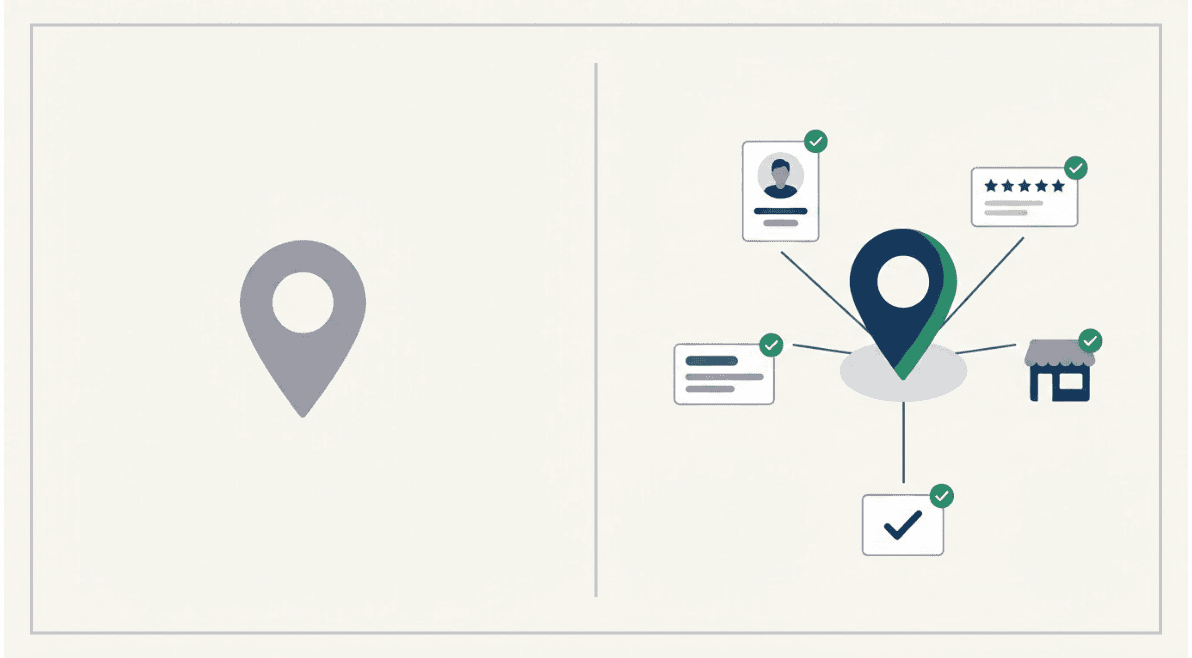
The problem is that stating your city and having an AI-verified local presence have become two different things, and only one of them still works.
This post argues local is now a matter of verification rather than a keyword tactic. Here, we explain what this means and offer simple steps you can take to align your own law firm online marketing strategy with it.
Local SEO Used to Be a Matching Problem. Now, It’s a Confidence Problem.
For most of the search era, geography was a string-matching exercise. A search engine looked for pages that contained the words “Tucson” (location) and “estate planning attorney” (keyword), weighed a few hundred other factors, and returned a ranked list of ten blue links plus a map. Your job was to make sure the right local keyword phrases appeared in the right places. Repetition may have been crude, but it was effective. The system was matching text, not evaluating claims.
AI-powered search works differently in one way that changes everything about legacy local SEO. As you know by now, when someone asks an AI assistant for an attorney, the system doesn’t return a list for the person to sort through. It commits to an answer, which is a much higher bar. When the AI system names a specific attorney, it needs some basis for confidence that the attorney is real, licensed, currently practicing, and actually available in that place.
Confidence of that kind does not come from your own claims about yourself. It comes from other sources on the internet that agree with or prove your claims.
Think about how referrals work in your own practice. If a colleague asks who handles guardianship matters in Pima County, you do not recommend the lawyer who talks the loudest about handling guardianship matters in Pima County. You recommend the name you have heard from three different directions: a court clerk mentioned her, you saw her present at a county bar section lunch, and a former client spoke well of her. Independent corroboration is what turns a claim into a fact you are willing to stake your reputation on.
AI systems are built to approximate that same logic. Your website is your claim. Everything else is the corroboration.
Keywords Still Matter. They’re Just Not Proof.
One clarification before going further: None of this means you should take your city off your website.
“Estate Planning Attorney in Phoenix” is still useful language. Plenty of prospective clients still type that phrase into Google, and a page that never mentions Phoenix will struggle to be relevant to it. AI systems read your pages too, and telling them plainly where you practice helps them. Put your city and your practice area in your page titles, your headings, and your copy wherever a normal person would naturally put them.
The shift is not from keywords to no keywords. It is from keywords as the whole strategy to keywords as the starting point. Saying “Phoenix estate planning attorney” tells a search system what you claim, and that claim still needs to be on the page. It just no longer finishes the job, because every other estate planning attorney in Phoenix is saying the same thing, and none of those words distinguish the attorney who has actually probated an estate in Maricopa County from the one who has not.
So keep the words. Then add the evidence.
What AI Systems Look For to Confirm You Practice Somewhere
There is no published checklist. Anyone who tells you they know the exact weighting is guessing. But through our own research on social proof and continued observations, certain categories of evidence keep coming up. These categories also line up closely with what a careful prospective client might check when considering whether you are the right attorney or firm to represent them.
| Signal | What It Tends to Confirm | Where a Solo or Small Firm Starts |
|---|---|---|
| Google Business Profile | A verified physical or service-area presence, current hours, and recent activity | Claim and verify the profile. Make the address match your website exactly, down to the suite number. (Pro tip: Start posting on your GBP when it’s fully set up.) |
| Client reviews with specific detail | Independent people describe real local matters, not generic praise | Ask at the close of a matter, following your state bar rules on testimonials. |
| State bar profile | Authority-grade confirmation of licensure status and office address | Log in and update it. Most attorneys have not touched theirs since admission. |
| Case results and matter descriptions naming the venue | You appear before specific courts, agencies, and county offices | Add the venue to results you already published. |
| Local citations and directory listings | The same name, address, and phone number repeat across unrelated sites | Fix the five listings that already exist before adding new ones. |
| Local organizational involvement | A real presence in the local legal and business community | County bar sections, chamber membership, nonprofit boards, CLE presentations. |
| Content only a local practitioner could write | Working knowledge of local procedure, not just local vocabulary | One page of substance beats fifteen city pages. |
None of this requires technical skill or a new website. It requires making sure that what you say about your practice can be confirmed by someone who is not you.
Claiming You Are Local Versus Proving You Are Local
Here is the distinction in practical terms.
A claim looks like this: “Serving clients throughout Maricopa County and the greater Phoenix area.”
Every firm site in the county says a version of this. It is unverifiable, and because everyone says it, it carries no information.
Proof looks like this: Your Google Business Profile lists 1240 E Washington St, Suite 210, and your state bar profile lists 1240 E Washington St, Suite 210, and your website contact page lists 1240 E Washington St, Suite 210. A client review says you helped her through a contested guardianship in Maricopa County Superior Court and mentions she drove in from Glendale. Your results page notes a business formation matter completed through the Arizona Corporation Commission. Your blog has a page explaining what the parent education class requirement means for a divorce timeline in Maricopa County, including what happens if you file before completing it.
None of that says “we serve the greater Phoenix area.” All of it proves it.
The consistency piece sounds trivial, but it’s not. The most common problem we see is not a missing signal. It is contradictory signals. A firm moves offices and updates the website but not the bar profile. A suite number appears on the website and is missing from three directory listings. Two phone numbers are in circulation because the old tracking number was never retired. Each discrepancy is small. Together, these discrepancies mean that various sources disagree about basic facts. A system built to name one firm has a reason to name the firm whose facts agree.
If you do nothing else after reading this, open a spreadsheet, list your name, address, suite, phone, and hours as they appear on your website, your Google Business Profile, your bar profile, and the first five directory results for your firm name, and reconcile the differences. That exercise takes an afternoon and often does more than a quarter of content work.
Why “Divorce Attorney in Phoenix” Is Not a Content Strategy
The dominant local SEO tactic of the last decade was the city page. Take your practice area page, duplicate it fifteen times, swap the city name, and publish “Divorce Attorney in Phoenix,” “Divorce Attorney in Mesa,” “Divorce Attorney in Chandler,” and so on through Tempe and Gilbert and Scottsdale.
That approach was always thin, and it has aged badly. To reiterate, the problem is not the words “Divorce Attorney in Phoenix.” The problem is publishing fifteen versions of the same page with the city swapped out and maybe rephrasing a few paragraphs, and then calling it a local strategy. Fifteen near-identical pages give an AI system no new information, and they compete with each other for the same ground.
Compare two approaches to the same goal.
The city page approach: fifteen pages, each roughly 600 words, each explaining that divorce is difficult and you are compassionate, each with a different city name inserted eleven times.
The substance approach: one page titled “How a Contested Divorce Works in Maricopa County Superior Court,” running 1,400 words, that walks through the actual sequence. Where the petition gets filed. The current filing fee. The parent education class requirement and what happens if you do not complete it. Realistic timelines based on your own docket experience, stated as ranges rather than promises. What the resolution management conference is and what actually happens at one. What a temporary orders hearing looks like from the client’s chair.
The second page proves local practice in a way the first fifteen cannot. It also serves an actual human being who might be anxious and looking for information, which is the audience you are trying to reach in the first place.
This applies well outside litigation. A business formation attorney in Boise can write about whether a client needs an Idaho address to form an Idaho LLC, what the Secretary of State’s processing times realistically look like, and which local licensing requirements catch new restaurant owners by surprise. Likewise, an estate planning attorney can explain how her county recorder handles beneficiary deeds, and what the local probate court expects in a small estate affidavit. This is location-specific content that no template can produce.
How to Build an AI-Verified Local Presence without Starting Over
You do not need a new website. Most firms already have the raw material; they just haven’t made it verifiable. A reasonable sequence is as follows:
- Reconcile your facts. The spreadsheet exercise described above. Do this first, because inconsistency undermines everything you add on top of it. (We have already been telling you to do this, so if you have, then move on to the next step.)
- Update your state bar profile. It takes ten minutes (if that), and it is one of the most authoritative sources about you on the internet.
- Make your Google Business Profile active rather than static. A profile that has not been touched in two years reads as an abandoned business. Post occasionally. Answer questions. Keep hours current, including holidays.
- Change how you ask for reviews. Instead of “would you leave us a review,” try “would you leave a review – it helps other people, especially if you mention the type of case and how we helped.” Specific reviews are more useful to future clients and more useful as corroboration. Follow your state’s rules on client testimonials carefully, do not offer anything of value in exchange, do not draft the review, and confirm you have consent before anything identifying a matter appears publicly.
- Add venue to results you already publish. If your results page says “$340,000 settlement in a premises liability matter,” adding the county and court, along with your jurisdiction’s required disclaimer language about prior results not guaranteeing future outcomes, makes the same content geographically verifiable. Our post on case results as AI-readable content goes deeper on structuring these.
- Replace your city pages with one page of real local substance. Pick your highest-value practice area, write the page only you could write, and redirect the thin city pages to it.
- Say yes to one local thing this quarter. A county bar section presentation, a chamber panel, a legal aid clinic. These generate mentions on sites you do not control, which is precisely what makes them valuable.
The Reframe Worth Keeping
Local used to be something you declared. You put the city in your title tag and the search engine took your word for it.
Local is now a conclusion that other sources draw about you. Your website is still the foundation, but it functions as a claim awaiting verification, and the verification lives in your bar profile, your reviews, your published results, your directory listings, and the substance of what you write about the places you actually practice.
The attorney in Tucson did not need a new website. She needed her bar profile to match her business card, three reviews that mentioned Pima County, and one page about trust funding that only someone who has sat with Tucson families could have written. That is a month of small, unglamorous work, and it is the difference between saying you are local and being verifiably local.
