
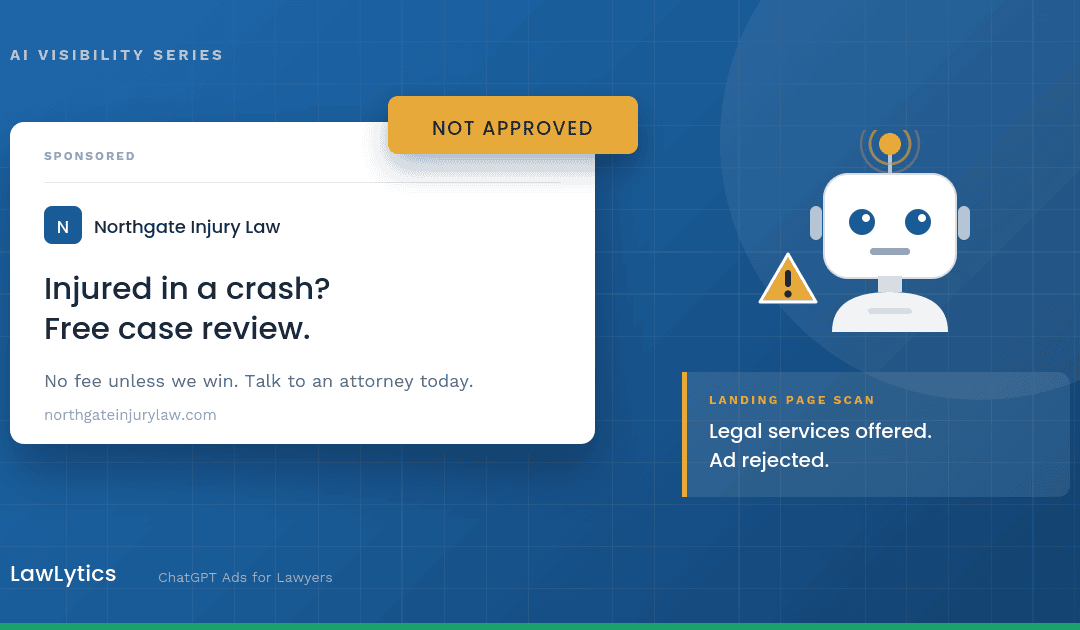
UPDATE – September 1, 2026: On August 31, the same day this article published, OpenAI updated its advertising policy to v1.5. Legal services ads are now permitted in the US when the advertiser is licensed to practice law in the jurisdiction where the ad is shown. Ads for legal services outside the US are still prohibited.
That reverses the central claim below, which was that the channel was closed to law firms. We have left the original wording in place with strikethroughs and put the corrected information next to it. Partly that is so the record is clear. Partly it is because the timing makes the point better than we could: This article was current for less than a day.
Three things did not change. Ads still reach only Free and Go users. They still do not appear in the sensitive contexts where a lot of your best cases start. And your state bar’s rules on attorney advertising apply exactly as they did before, which now makes them the tightest constraint on the channel rather than the second one. The advice in the second half of this article, about what to do with your own website, holds up.
Key Takeaways
|
You’ve probably seen the ads. They’re turning up on LinkedIn posts and all over Facebook. Free webinar. Sixty minutes. The lawyer’s playbook for advertising on ChatGPT. Seats are limited. Your competitors are already in (or get the playbook before your competitor does).
The pitch works because the premise is real. People are asking ChatGPT what to do after a car accident, whether a DUI charge needs a lawyer, and how custody actually gets decided in their state. Those are exactly the moments many lawyers pay good money to capture, and they are doing it via paid-per-click (PPC) campaigns. Sometimes they work; sometimes they don’t.
Here’s what the webinars on ChatGPT ads tend to skip: Right now, you can’t buy them. Not because you’re late, and not because your agency hasn’t figured out the trick. OpenAI’s own published policy says law firms can’t run ads for legal services. Of course, there are those who claim they know a work-around but is it really? We’re here to sort it all out for you.
Here’s what the webinars on ChatGPT ads tend to skip: Until August 31, 2026, you couldn’t buy them at all. Not because you were late, and not because your agency hadn’t figured out the trick. OpenAI’s own published policy said law firms couldn’t run ads for legal services, and it said so for the first six months the channel existed. Then it changed overnight, on the day we published this. Which is the real lesson here, and the reason we’re leaving the original text visible: the answer to “can I advertise on ChatGPT” has a date attached to it, and the date moves.
How Do ChatGPT Ads Work for Law Firms?
ChatGPT ads are not banners. They do not appear inside the AI’s answer. Each ad shows up below the response. They are labeled as sponsored content. They are visually separated from the chat. Each ad includes the advertiser name, a headline, a description, an image, and a link.
Two things matter more than the format:
- Ads don’t influence answers. They run on a separate system, and advertisers can’t shape or rank what ChatGPT says. Buying an ad doesn’t buy you a recommendation.
- Only users on the Free and Go plans see ads at all. Anyone on Plus, Pro, Business, Enterprise, or Edu sees none, and neither do accounts identified as belonging to anyone under 18.
You do not buy keywords for these ads. Advertisers describe conversation contexts. OpenAI’s system then decides where to serve the ad. There is no exact match targeting. Placement is not guaranteed.
For reference, here’s how ChatGPT ads compare to Google ads.
| Google Ads | ChatGPT Ads | |
|---|---|---|
| What you buy | A keyword | A conversation context, loosely |
| Who sees it | Anyone searching | Free and Go users, 18+ |
| Legal services allowed? | Yes, with rules | |
| Track record | Two decades | Live in the U.S. since February 2026 |
Are ChatGPT Ads Allowed for Law Firms?
If it’s legal services you want to advertise, then no, law firms cannot advertise on ChatGPT. OpenAI’s policy has a disallowed list covering regulated and sensitive categories, and legal sits on it next to gambling, political advocacy, and adult content. The prohibition covers ads for legal advice, representation, or legal services, offered to individuals or to businesses, and it names immigration, personal injury, legal claims, and document preparation as examples. Yes, within the US, provided key conditions are met. Effective August 31, 2026, OpenAI officially removed legal services from its disallowed list. Advertisements promoting legal advice, representation, or services to individuals or commercial entities are now allowed in the US, as long as the advertiser holds a valid license to practice law within the jurisdiction where the ad is displayed. Practice areas such as immigration, personal injury, and document preparation are explicitly cited as eligible. Broad legal education and media offerings remain permitted under their existing terms. However, ads for legal services outside the US are still banned, meaning firms handling cross-border matters cannot assume these permissions apply internationally.
The pivotal term in this policy update is “shown,” rather than “based”. Accountability rests on where your ad is delivered, not where your physical practice operates.
The one exception is narrower than it sounds (and it’s precisely the loophole many of those free webinars attempt to capitalize on). General legal education or media may be allowed where no legal service is offered. OpenAI’s own examples are a legal-themed podcast and an LSAT prep course. That’s the company you’re being invited to keep. What used to be the only lane is now just one of the options. General legal education and media are still permitted where no legal service is offered, which is where the webinar crowd was pointing everyone as recently as last week. It is no longer the workaround. It is simply a choice about what you want the ad to do.
You’ll hear two counterarguments to this, and both should be addressed head-on:
- Case-by-case approval claims:
While OpenAI mentions potential case-by-case approvals for legal advertisers, the broader policy tells a different story. Unlike financial or health services – where eligible categories like auto loans or dental care are clearly itemized – the legal sector receives no such list. It faces a blanket prohibition offset only by a narrow education exception. While not a permanent ban, this does not represent a viable approval path today.This one resolved itself. On August 31, the legal sector got what financial and health services already had, which is a named place in the policy with conditions instead of a blanket prohibition. - The April 2026 restriction updates: The April 2026 update adjusted placement rules rather than advertiser permissions. Placement rules determine which conversations can display ads, whereas permission rules dictate who can purchase ad space. Although the update allowed general local service ads to appear alongside user prompts about accidents, it did not grant law firms permission to buy those ads. (That distinction between placement rules and permission rules is exactly what happened on August 31. Permission changed. Placement did not.)
Understanding placement rules is essential for allocating your ad budget effectively, and real-world scenarios illustrate this far better than legal policy terms.
Think about the questions that turn into your best cases. Someone typing at two in the morning that their husband was killed by a drunk driver. A daughter asking whether the bruises she found on her mother at the nursing home are worth reporting. A woman asking how to leave with her kids and what happens after that.
None of those conversations will show your ad. OpenAI blocks ads from what it calls sensitive contexts, which covers personal and mental health conversations, emotionally reliant conversations, and sensitive user journeys. That block did not move on August 31. Legal services opened up. These did not.
What the channel does reach is the calmer version of the same person, days or weeks later. How long do I have to file a claim in Tennessee? What does a probate attorney usually charge? Is a first-offense DUI a misdemeanor? That is real intent, and it is worth showing up for, but it is the research phase, not the moment of the crash.
This distinction is critical for setting your budget effectively. If your client acquisition strategy relies on connecting with individuals during their most critical moments of need, ChatGPT advertisements will not reach them in those instances.
But (and this is important) within those sensitive conversations with ChatGPT, what does surface? Ads, we know, don’t. It’s ChatGPT’s own response, along with cited sources, and the latter could either belong to your firm’s website or a competitor’s.
Why Landing Page Compliance Matters for AI Ads
OpenAI reviews three things: (1) the advertiser; (2) the ad itself; and (3) the destination. An approved ad can’t point to a page that introduces disallowed content. The ad and the page have to be consistent all the way through.
Trying to trick OpenAI’s review process is a losing game. You could draft a pristine, educational headline, but you’ll still face rejection if your landing page behaves like a typical law firm site. If that page includes ‘Free Consultation’ buttons, a ‘Results’ carousel, or a chat widget asking if the visitor wants to speak to an attorney, the crawler will flag it immediately. While these conversion tools are essential for your business, they constitute ‘disallowed content’ in OpenAI’s view. Simply put: If your landing page attempts to sell legal services, the ad will be rejected, regardless of how clean your ad copy is.
This is the paragraph the August 31 update changed most. A consultation button, a results carousel, or a chat widget is no longer disallowed content on its own, because selling legal services is no longer disallowed. What still applies is consistency and accuracy. The destination must clearly relate to the advertiser and the offer in the ad, and it cannot mislead. So, a “Results” carousel is not a policy problem now, but an unqualified one is still a bar problem.
There’s a practical layer, too. As we said, OpenAI validates landing pages with a crawler, and if your firewall, bot protection, or robots.txt blocks it, your ad sits in review with nothing visibly wrong.
Sit with what that adds up to. To run a ChatGPT ad, you need a page with genuinely useful content, no sales pitch, clear authorship, and open access to AI crawlers. That isn’t an advertising specification. It’s a description of a good law firm website, which is the same thing that earns you citations in AI answers for free. To run a ChatGPT ad well, you need a page with genuinely useful content, clear authorship, and open access to AI crawlers. The no-sales-pitch requirement is gone. This sounds like a description of a good law firm website, which is the same thing that earns you citations in AI answers for free.
If You Try to Run a ChatGPT Ad – Here’s What to Do and Not to Do
If you decide to pursue the education lane anyway, here’s the line between an ad that gets reviewed and one that gets rejected on sight. The table below was written for the education-only lane that existed before August 31. The “Don’t” column is no longer an automatic rejection, so read it now as a guide to the education approach specifically, or as a record of how narrow this channel was a day ago. If you are advertising legal services directly, the section right after this one is the one that governs you.
| Don’t | Do |
|---|---|
| “Injured in a crash? Free case review.” | “The six things to document after a collision.” |
| “No fee unless we win.” | A plain-English guide to reading a police report. |
| Point the ad at your homepage. | Point it at a standalone educational page. |
| Put a contact form on the landing page. | Offer the resource itself, and nothing else. |
| Assume rejection is a wording problem. | Check the landing page first. It usually is the landing page. |
Then there’s the layer OpenAI doesn’t govern. Platform policy is theirs. Your rules of professional conduct are your bar’s, and they were written for billboards.
None of what follows changed on August 31. It moved from being the second hurdle to being the only one, which is still a bigger deal than it sounds.
Three things to raise with your own bar rules in front of you:
- Direct chatbot ads hit closer to targeted solicitation than standard search ads, an area no state bar has formally addressed yet.
- Geographic targeting places the burden on you to prevent ads from reaching states where you aren’t licensed. If mandatory disclaimers apply, figure out how to squeeze them into a headline and single line of copy before writing your ad.
- Because your educational landing page counts as an attorney communication, prohibition against false or misleading statements applies just as strictly as on any traditional medium.
Even if you clear all three hurdles, consider what remains: your ad cannot promote legal services, your landing page cannot request a consultation, and your audience is restricted to free-tier users. Ultimately, you’re paying for brand awareness. Your audience is still limited to Free and Go users over 18, your ad still won’t appear in the conversations you most want, and you still can’t buy a specific keyword. You can now ask for the consultation, which is a real change. Whether the traffic that remains is worth the spend is a question the policy update did not answer for you.
Brand advertising has value, but it is rarely the best initial investment for solo practitioners, especially with no straightforward conversion path to measure. Reporting is built around clicks and pixel conversions, and most law firm intake still happens on the phone.
What Should Law Firms Do Instead of ChatGPT
LawLytics doesn’t sell PPC and doesn’t manage ad campaigns, so we have no stake in whether you buy clicks. What we care about is what happens after someone arrives.
Paid ads work as a temporary bridge or a targeted supplement, useful when you’re entering a new practice area, opening a second location, or waiting on a new site to gain traction. They stop making sense when they become the entire plan. Ads buy traffic only while you keep paying. Your website is the asset you keep.
That’s also the answer to the cheaper-clicks version of the pitch. The price of a click was never the number that matters. The price of a signed client is.
Run the arithmetic. Say clicks come in at twenty dollars, which would be cheap for legal. A hundred of them costs you two thousand. Three of those hundred call or fill out the form. One signs a thirty-five hundred dollar flat fee. Ultimately, your month netted fifteen hundred dollars. Next month, you start over at zero and pay for the clicks again.
Now the same signed client from the other direction. Someone reads your DUI practice area page, calls the number at the top, and signs the same thirty-five hundred dollar engagement. That page cost you an afternoon so that you could write it, once. It is still working in October, and in October, it costs you nothing.
Both of those clients typed the same question into the same chatbot. What separates them is what you paid for the introduction, and whether you have to pay for it again next month.
What this means: If OpenAI opens legal services next year, the firms ready to advertise well will be the ones that already published real educational content on an accessible site. The prep work for the ad channel and the prep work for the organic channel are the same work. We wrote that OpenAI might open legal services next year. It opened them the day this published, which is worth admitting because of what it says about waiting. The firms with real options this morning are not the ones who called the timing right. They are the ones who made the timing irrelevant. They published useful content on an accessible site, so the door opening gave them somewhere worth sending an ad, and the months it was closed gave them citations they never paid for. The work that earns those citations and the work that makes an ad worth buying are still the same work. One of them you can start today, and it costs you nothing per click.
| Priority | What to do | Why it pays either way |
|---|---|---|
| 1 | Make your practice area pages answer the questions clients actually ask, in plain language | Earns organic citations now, and becomes ad-eligible content later |
| 2 | Confirm AI crawlers can reach your site | Required for ad review, and it’s how AI systems read you today |
| 3 | Publish one genuinely useful standalone resource on your own domain | The only asset with any path through legal ad review |
| 4 | Get your Google Business Profile and reviews in order | Still where local legal intent converts fastest |
| 5 | Treat any paid spend as a bridge, not the plan | ChatGPT ads aren’t a channel you can shift budget into anyway |
On that third one (the resource), the location matters as much as the content. Publish the resource on your own domain as a real page. It should not be a gated PDF sitting on a third-party landing page tool or a post on LinkedIn or Medium. You want the crawler to reach it. You want the search and AI visibility equity to accrue to your site. And you want to still own it if you change marketing vendors.
There’s one complication, though. If that page is ever going to serve as an ad destination, it can’t carry your site’s usual consultation button, chat widget, or case results, because the ChatGPT review will look at the whole page. So allow the resource to live on your own domain but publish it without the conversion elements that would sink the ad.
The Bottom Line on ChatGPT for Lawyers in 2026
The webinar appearing in your feed promotes access to a channel that remains effectively closed to you (with no guarantee of when or if that will change). Even so, ignoring ChatGPT is a mistake. The real priority is making sure your own website is optimized to appeal to AI platforms.
Your website serves as the primary source AI systems analyze, the benchmark potential clients use to evaluate your practice, and the required destination for any future ad campaigns. Focusing on building a strong website first is essential. And in doing so, you may discover that paid ads are unnecessary.